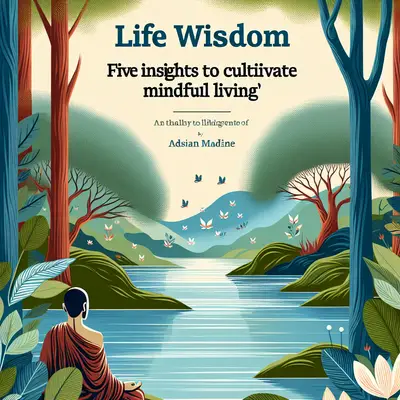

Life rarely announces its turning points. They arrive quietly—an unexpected pause in your day, a conversation that lingers, a feeling that something needs to change. Mindful living is not about escaping the noise of life, but about learning to listen underneath it. It’s the slow, steady art of walking yourself home to who you really are, one honest moment at a time.
The following five insights are not quick fixes or grand philosophies. They are small, steady practices that help you meet your own life with more presence, kindness, and courage.
1. Treat Your Attention as Your Most Precious Currency
Your life is, in many ways, what you repeatedly pay attention to. Every notification, every scroll, every distraction is a quiet request: “May I have a piece of your life?” The wise question is not just, “What am I doing with my time?” but “What am I doing with my attention?”
Mindful living begins with noticing where your attention goes automatically. Do you reach for your phone the moment you feel bored, lonely, or uncertain? Do you replay old arguments or anxieties in your mind without realizing you have a choice to disengage? Start by observing yourself gently, not as a critic but as a witness. One simple practice: choose one daily activity—drinking your morning coffee, washing dishes, walking from your car to your door—and give it your full attention. Feel the temperature, notice the sounds, watch your thoughts come and go. By repeatedly reclaiming small islands of full attention, you train yourself to be more present in the larger, harder moments too. Over time, you realize: presence is not a luxury; it is how life is actually experienced.
2. Make Peace with Imperfection (In Yourself and Others)
Much of our suffering comes not from what happens, but from the gap between how life is and how we think it should be. We carry silent scripts: “I should be further along,” “They should understand me,” “My life should look different by now.” These “shoulds” are heavy; they turn ordinary days into constant self-judgment.
Mindful living invites a different posture: one of honest acceptance. Acceptance is not resignation; it is simply the willingness to see what is true without immediately waging war against it. You can start with small, everyday imperfections: the unwashed dishes, the missed workout, the awkward conversation that didn’t go as planned. Instead of attacking yourself, try saying, “This is how it is right now.” Notice how your nervous system responds when you stop demanding perfection and allow reality to be what it is. When you extend this same grace to others—allowing them to be complex, unfinished, occasionally clumsy humans—you loosen the tight grip of resentment and disappointment. Life becomes less about enforcing a script and more about meeting each moment with curiosity and compassion.
3. Learn to Pause Between Feeling and Reaction
Most regrets are born in the space where we don’t pause. We feel triggered, threatened, ignored, embarrassed—and words fly out, doors slam, messages are sent that our calmer self would never endorse. The practice of mindful living rests heavily on a single skill: creating a small, sacred gap between what you feel and what you do.
That gap doesn’t need to be long. Sometimes three breaths are enough. In a heated moment, before responding, try silently naming your emotion: “Anger is here,” “Fear is here,” “Shame is here.” Naming helps you step half a step back from being the feeling and instead become the one observing it. You might still choose to speak firmly, to set a boundary, to walk away—but the action comes from a steadier place, not from the peak of reactivity. Over time, this pause becomes a kind of inner refuge. You discover that you can hold strong emotions without being ruled by them. This is not only good for your relationships; it’s an act of deep self-respect.
4. Let Your Values, Not Your Mood, Lead the Way
Our moods are weather: constantly shifting, often unpredictable, not entirely under our control. Values, on the other hand, are more like climate—stable patterns that reflect what matters most to us over time. Mindful living means learning to live by the compass of your values rather than the storms of your emotions.
Begin by asking: “When I am at my best—when I feel most like myself—what qualities am I living out?” It might be kindness, courage, honesty, creativity, or service. Write them down. Then, in ordinary moments, practice choosing one small action that reflects these values, regardless of how you feel. Maybe you’re tired, but you value connection, so you listen a little more attentively to your partner. Maybe you feel anxious, but you value growth, so you still submit the application or start the project. Each time you act in alignment with your values, you strengthen a deeper sense of integrity and self-trust. Life becomes less about chasing good moods and more about embodying what truly matters to you—even on the days when you don’t feel like it.
5. Honor Your Limits as Tender Forms of Wisdom
In a culture that worships productivity and constant availability, it can feel almost rebellious to say, “I’m at my limit.” Yet mindful living requires that we be honest about our physical, emotional, and mental boundaries. Your limits are not flaws to be fixed; they are messages from your body and spirit about what they can carry right now.
Start by noticing your early warning signs of depletion: maybe you get more irritable, your sleep is restless, your chest feels tight, or your joy in small things begins to fade. Rather than pushing past these signals, treat them as wise requests for care. This might mean saying no to one more commitment, stepping away from a draining online argument, or allowing yourself genuine rest without labeling it laziness. When you honor your limits, you are not abandoning your responsibilities; you are sustaining your capacity to show up for them over the long term. In this way, self-care is not indulgence but stewardship—of your energy, your attention, and your ability to love well.
Conclusion
Mindful living is not a different life; it is a different way of meeting the life you already have. Treating your attention as sacred, making peace with imperfection, pausing before you react, letting values guide you, and honoring your limits—these are quiet practices. They won’t always be visible to others, but they steadily reshape the inner landscape from which your choices arise.
You don’t need to transform everything at once. Choose one insight that speaks to you and practice it in modest, consistent ways. Over time, these small acts of awareness and kindness accumulate. You may find that you are no longer running away from your life or trying to control it into perfection. Instead, you are walking yourself home—step by step—into a way of being that feels truer, gentler, and deeply your own.
Sources
- National Institutes of Health – Mindfulness Meditation: A Research-Validated Practice - Overview of what mindfulness is and evidence on its benefits for mental and physical health
- American Psychological Association – Mindfulness, Meditation, and the Brain - Explores how mindfulness affects the brain and emotional regulation
- Harvard Health Publishing – Mindfulness for Your Health - Discusses practical applications of mindfulness and its impact on stress and well-being
- Greater Good Science Center, UC Berkeley – What Is Mindfulness? - Provides research-based insights into mindfulness, compassion, and emotional skills
- U.S. Office of Disease Prevention and Health Promotion – Self-Care and Healthy Living - Offers guidance on self-care, mental health, and maintaining healthy relationships
Key Takeaway
The most important thing to remember from this article is that this information can change how you think about Life Wisdom.