
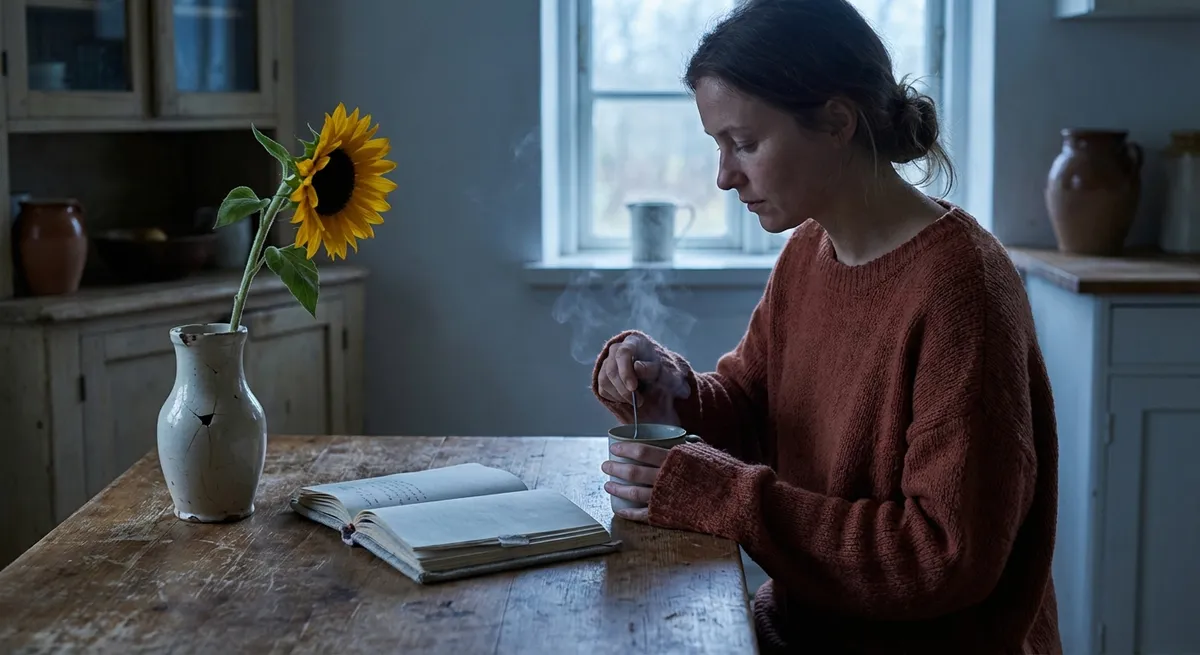
We are rarely taught how to be present for our own lives. We learn how to plan, strive, and achieve—but not how to inhabit this very moment with any depth. Mindful living is not about escaping the world or becoming perfectly calm; it is about learning to be awake, honest, and kind in the middle of ordinary days. When we practice this, life doesn’t necessarily get easier, but it does become more real, more livable, and often, more gentle.
Below are five insights that can help you live more mindfully—not by adding more to your to‑do list, but by changing the way you move through what’s already there.
1. Attention Is Your Real Home
Most of us live scattered—half in the past, half in the future, and rarely where our body actually is. Emails tug us in one direction, worries in another, and our attention is constantly outsourced. Mindful living begins with recognizing that where your attention goes, your life actually happens. Your real home is not your job, your house, or your plans. It is your present-moment awareness.
Try noticing, a few times a day, “Where is my attention right now?” You might find it chewing on an old conversation or rehearsing a future argument. Gently invite it back to what is directly here: the sensation of your feet on the floor, the sound of someone speaking, the feeling of your own breath. This is not a performance; it is an honest check-in with reality.
The more you practice, the more you discover that attention is a kind of inner refuge. You can’t control what life brings, but you can choose where you rest your awareness, again and again. Over time, this becomes a stable ground—a place you can return to when life feels uncertain or overwhelming.
2. Your Breath Is a Moving Anchor
The breath is the simplest, most portable tool for mindful living, and yet most of the time we barely notice it. We hold it in frustration, speed it up with anxiety, or shallow it with constant busyness. Turning toward the breath is less about technique and more about relationship—how you treat your own life force.
All you need to do is notice: “How am I breathing right now?” Is it tight, rushed, or barely there? Without judgment, let the breath lengthen slightly on the exhale. You might silently think, “Inhale—here. Exhale—now.” This tiny pause interrupts old patterns of reactivity. It slows down the moment just enough that you can choose your response instead of being swept away by habit.
Practicing this while doing ordinary tasks—washing dishes, walking to the car, waiting for a page to load—turns daily life into a kind of informal meditation. Your breath becomes an anchor that moves with you, a reminder that, no matter what the mind is doing, there is always something steady and simple to return to.
3. Feelings Are Messengers, Not Enemies
Modern life often treats difficult emotions as problems to fix or evidence that something has gone wrong. Mindful living offers another view: feelings are messengers. They are information about how your inner world is responding to your outer world. Ignoring them doesn’t make them disappear; it just drives them underground, where they shape your choices from the shadows.
The practice is to let emotions be present without immediately acting on them or drowning in their storylines. When you feel anger, sorrow, jealousy, or fear, you might pause and name it gently: “This is anger.” “This is grief.” “This is anxiety.” Naming creates a little space. You are acknowledging the emotion without becoming it completely.
Then, shift your attention from the story in your head to the sensations in your body. Where do you feel it? Tightness in the throat? Weight in the chest? Heat in the face? Stay curious. Often, just a few seconds of kind attention begins to soften the edges. You may discover that emotions move like weather—arriving, intensifying, and passing through. Mindful living doesn’t insist you feel a certain way; it teaches you to relate wisely to whatever you feel.
4. Slowness Is Not Laziness, It’s Discernment
We live in a culture that glorifies speed and productivity. Slowing down can feel like failure, or even a threat to your identity. Yet a life lived in constant acceleration rarely allows room for depth, reflection, or genuine joy. Mindful living asks a courageous question: “What am I rushing past?”
Slowness is not about doing less for its own sake; it is about doing what matters with your whole self. It might look like taking a breath before answering an email that triggers you, pausing for a few seconds before saying yes to a new commitment, or walking a little more slowly from one room to another, just to feel your steps.
This kind of slowness builds discernment. When you are not frantically reacting, you can better sense what is aligned with your values and what is simply habit or pressure. Over time, you may discover that many urgencies are not truly urgent—and that some quiet, easily ignored signals (your fatigue, your intuition, your need for connection) are more important than you realized.
In choosing a more deliberate pace, you’re not opting out of life; you’re finally giving yourself enough space to live it with clarity.
5. Small Daily Rituals Shape Who You Become
We often wait for big changes—a new job, a move, a relationship shift—to feel like our life has turned a page. Mindful living invites you to look closer: the true arc of your life is being written in your smallest, most repeated moments. What you do daily, almost without thinking, gently shapes who you become.
Consider choosing one or two small rituals and infusing them with attention. It might be your first sip of tea or coffee in the morning, a brief pause before turning on your phone, a short walk after lunch, or a few quiet breaths before sleep. The ritual itself doesn’t have to be impressive. What matters is the quality of presence you bring to it.
As these mindful pockets accumulate, they begin to change your inner landscape. You are training yourself to remember: “My life is happening here, now—not just in my plans or worries.” These rituals also act as touchstones on difficult days. Even when everything else feels unpredictable, there is something simple, grounded, and familiar you can return to.
Mindful living isn’t about redesigning your whole existence overnight; it’s about gently tilting the axis of your days toward awareness and kindness, one small ritual at a time.
Conclusion
Mindful living is not a finish line you cross or a persona you adopt. It is an ongoing relationship with your own life—an agreement to show up with as much honesty, steadiness, and compassion as you can muster in this moment, and then the next.
By reclaiming your attention, returning to the breath, listening to your emotions, honoring a more deliberate pace, and tending to small daily rituals, you begin to live from the inside out instead of the outside in. Life will still be imperfect and unpredictable, but you may find yourself meeting it with a clearer mind and a softer heart.
You do not need to become a different person to live more mindfully. You only need to be willing to meet yourself where you already are.
Sources
- National Institutes of Health – Mindfulness Meditation: What You Need To Know – Overview of mindfulness, health benefits, and research findings
- American Psychological Association – Mindfulness, Meditation, and the Brain – Explores psychological and neurological effects of mindfulness practices
- Harvard Medical School – Mindfulness Meditation May Ease Anxiety, Mental Stress – Summarizes research on how mindfulness impacts stress and anxiety
- University of California, Berkeley – Greater Good Science Center: What Is Mindfulness? – Clear definition of mindfulness and its applications in daily life
- Mayo Clinic – Meditation: A Simple, Fast Way to Reduce Stress – Practical guidance on starting a meditation practice and its benefits
Key Takeaway
The most important thing to remember from this article is that this information can change how you think about Mindful Living.