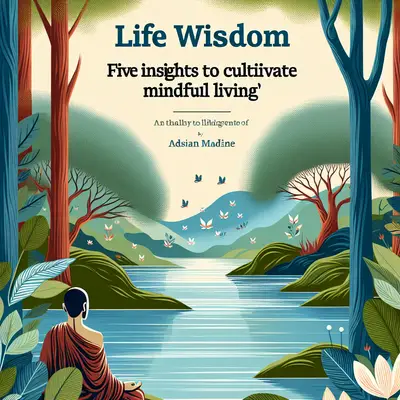

Most days do not arrive with grand announcements. They slip in quietly—through the steam of your morning coffee, the buzz of your phone, the traffic light that just turned red when you were in a hurry. In the rush to get things done, we often miss the simple, steady wisdom tucked into these ordinary moments.
Mindful living is not about escaping your life or turning every second into a spiritual exercise. It’s about relating to your life differently—being awake enough to notice what it’s already teaching you. The day is speaking, but softly. The question is whether we are willing to listen.
Below are five insights that can gently reshape how you move through your day—not by adding more to your to‑do list, but by changing the way you meet what’s already there.
Insight 1: Your Attention Is Your Real Home
Where your attention goes, your life quietly follows. You can be in the same room with people you love and yet be miles away in your mind, lost in unfinished tasks or old arguments. Over time, this subtle distance can leave you feeling oddly homeless in your own life.
Notice, even for a moment, where your attention tends to wander when you are tired, stressed, or bored. Does it race ahead to worry? Drift back to regret? Get stuck in replaying conversations? Instead of judging this, simply label it: “planning,” “remembering,” “worrying.” This simple naming can interrupt the spell and bring you back to where your feet actually are.
You don’t need a perfect meditation setup to do this. Standing in line, waiting for your food to heat up, sitting at a red light—these are all invitations to quietly come home to your senses. Feel the contact of your feet on the ground. Notice your breath without trying to fix it. Glance around and name three things you can see. The moment may feel small, but each time you reclaim your attention, you lay another brick in the foundation of a steadier inner home.
Insight 2: You Don’t Have to Believe Every Thought
The mind is an excellent storyteller and a terrible moderator. It offers commentary on every situation: “You’re behind.” “They must be upset.” “You always do this.” These thoughts can feel like breaking news when, in reality, they’re often reruns.
A useful question is: “Is this a fact, or is this a story?” Facts are simple: “The email has not been answered.” Stories pile on assumptions: “They’re ignoring me,” “I must have done something wrong,” “This will be a disaster.” The more we fuse with the story, the more it shapes our mood, our choices, and our sense of self—often without our consent.
Mindful living doesn’t mean getting rid of difficult thoughts. It means recognizing them as mental events passing through, not orders you must obey. You might experiment with saying silently, “I’m having the thought that…” For example, “I’m having the thought that I will fail,” instead of “I will fail.” That slight distance can create just enough space to choose a wiser response.
Over time, you may discover that many of your most convincing inner narratives are actually old scripts, not present truths. You can let them pass through like weather rather than building a house under every storm.
Insight 3: Small Pauses Quietly Change Big Patterns
We often wait for big moments—vacations, new jobs, major decisions—to reset our lives. Yet much of our suffering is shaped in the smaller spaces: the five seconds before we answer a sharp comment, the brief moment before we open an app, the breath we take (or don’t) before we respond to a difficult email.
A pause does not have to be long to be powerful. The simplest version is “one conscious breath.” In a challenging moment, feel one full inhale and one full exhale, noticing the rise and fall in your body. That’s it. You are not solving anything during that breath; you are simply stepping out of automatic reaction long enough to remember you have a choice.
These micro-pauses can gently loosen long-standing patterns. Maybe you still feel irritation, but you don’t send the hastily written message. Maybe you still feel anxious, but you decide not to check your phone for the tenth time in a row. The outer action may look small, yet each pause is a quiet vote for a different kind of day.
The more these pauses are woven into ordinary moments—transitioning between tasks, walking through a doorway, sitting down to eat—the more your nervous system learns that slowing down briefly is not dangerous, but grounding.
Insight 4: Your Body Often Knows Before Your Mind Admits
We like to think we live mostly in our heads, but the body often tells the truth first. A tight jaw before you admit you’re angry. A knot in the stomach before you say, “I’m fine.” A sense of heaviness before you realize you’re exhausted rather than “just a bit off.”
Mindful living invites you to treat your body not as an obstacle to overcome, but as a quiet, trustworthy source of information. A starting point is simple, regular check-ins during the day—no special posture needed. Ask, “What sensations are here right now?” Warmth, tension, buzzing, lightness, pressure—let the body answer in its own language, without quickly translating everything into “good” or “bad.”
Sometimes the wisest action is not to push through one more thing, but to honor what the body is whispering: take a short walk, drink water, stretch your shoulders, step outside for two minutes of fresh air. These choices may seem too ordinary to matter, yet they create a relationship with yourself in which you are listened to, not constantly overridden.
The more you attend to your body in quieter moments, the more you’ll be able to hear it when life gets loud. This can help you sense burnout earlier, notice when a boundary has been crossed, or recognize when an opportunity feels genuinely right rather than simply expected.
Insight 5: Gentle Curiosity Is Stronger Than Harsh Judgment
Many of us speak to ourselves in ways we would never speak to a friend. We criticize, compare, and question our worth with remarkable efficiency. This inner harshness often masquerades as motivation, but more often it leaves us drained, guarded, and afraid to try.
Curiosity offers another path. Instead of “What’s wrong with me?” you might ask, “What’s happening in me right now?” Instead of “I failed again,” try, “What can I learn from how that went?” The circumstances may be the same, but the inner stance is profoundly different.
Curiosity does not deny difficulty; it simply refuses to make you the enemy. It allows you to see patterns with more clarity because you are not busy defending yourself against your own judgment. From this clearer place, it becomes easier to take responsibility where needed, apologize when appropriate, and still remember that a mistake is something you did, not something you are.
Cultivating this gentler voice is not indulgence; it is maintenance. A kind inner environment makes it more likely that you’ll tell yourself the truth, stay engaged with growth, and extend the same compassion to others. In a world that often rewards hardness, quiet curiosity is a radical, powerful form of strength.
Conclusion
A mindful life is not built in dramatic moments; it is shaped in hundreds of small, nearly invisible decisions: where you place your attention, how you relate to your thoughts, whether you pause before you react, how you listen to your body, and the tone you use when you speak to yourself.
You do not have to fix your entire life to begin living more wisely today. You only have to choose one small place to practice: one breath before answering, one gentle question instead of a harsh judgment, one moment of noticing your feet on the floor before you rush into the next thing.
The day will keep offering you these quiet openings. When you meet even a few of them with awareness, something in you begins to settle—not because life has become easier, but because you are finally standing inside it with both eyes open.
Sources
- [National Institutes of Health – Mindfulness and Health](https://www.nccih.nih.gov/health/mindfulness-meditation-what-you-need-to-know) - Overview of mindfulness, its benefits, and research-based insights
- [American Psychological Association – The Path to Mindfulness](https://www.apa.org/monitor/2012/07-08/ce-corner) - Explores how mindfulness affects thoughts, emotions, and behavior
- [Harvard Health Publishing – Mindfulness Meditation May Ease Anxiety, Mental Stress](https://www.health.harvard.edu/mind-and-mood/mindfulness-meditation-may-ease-anxiety-mental-stress) - Summarizes research on how mindfulness supports mental well-being
- [Mayo Clinic – Stress Management: Mindfulness Exercises](https://www.mayoclinic.org/healthy-lifestyle/stress-management/in-depth/mindfulness-exercises/art-20046356) - Practical guidance on simple practices like breathing and body awareness
- [Greater Good Science Center, UC Berkeley – The Science of Mindfulness](https://greatergood.berkeley.edu/topic/mindfulness/definition) - Explains mindfulness and its effects using current psychological and neuroscientific research
Key Takeaway
The most important thing to remember from this article is that this information can change how you think about Life Wisdom.